

Breast implant placement is an important part of the breast augmentation process and can influence everything from the final appearance of the breasts to recovery and long-term comfort. One of the most common decisions discussed during consultation at our specialist plastic surgery clinics in London and Hertfordshire is whether implants should be placed under or over the chest muscle.
Both approaches are widely used in breast augmentation surgery, but each offers different advantages depending on factors such as body shape, tissue coverage, lifestyle and the type of result a patient wishes to achieve. Understanding the differences between under-the-muscle and over-the-muscle implant placement can help patients make a more informed decision.
Are Under-the-Muscle or Over-the-Muscle Implants Better for You?
Under-the-muscle and over-the-muscle breast implants each offer different advantages depending on your anatomy, tissue coverage, lifestyle and aesthetic goals. Under-the-muscle placement is often recommended for patients with less natural breast tissue because the chest muscle provides additional coverage over the implant, helping create a softer, more natural-looking result.
Over-the-muscle placement may be more suitable for patients who want greater fullness in the upper breast or who prefer a recovery that is often associated with less pressure and muscle-related chest discomfort during the early healing period.
What Does Implant Placement Mean?
Implant placement refers to where the breast implant sits in relation to the pectoralis major, the large chest muscle that covers much of the upper chest wall. The position of the implant can influence the final shape, feel, recovery and overall appearance of the breasts following augmentation.
Over the Muscle Placement (Subglandular)
In over-the-muscle placement, also known as subglandular placement, the implant sits between the natural breast tissue and the chest muscle. The pectoralis muscle is not lifted during surgery, and the implant is supported by the existing breast tissue and skin.
This approach may be suitable for patients with sufficient natural tissue coverage and is often chosen to achieve greater fullness in the upper breast.
Under the Muscle Placement (Submuscular)
In under-the-muscle placement, the implant is positioned beneath the pectoralis major muscle. Depending on the surgical technique used, the implant may be fully or partially covered by the muscle and surrounding supportive tissues.
Additional muscle coverage can help create a smoother transition along the upper breast and may reduce the visibility of implant edges or rippling, particularly in patients with thinner tissue coverage.
Dual-Plane Breast Augmentation
Modern breast augmentation techniques often use dual-plane placement, which combines elements of both approaches. In this technique, the upper portion of the implant sits beneath the muscle, while the lower portion sits more directly behind the breast tissue.
This allows for muscle coverage in the upper breast, where implant visibility is more common, while still allowing the lower part of the implant to settle naturally within the breast shape. Dual-plane techniques are commonly used to balance natural contours with implant support.
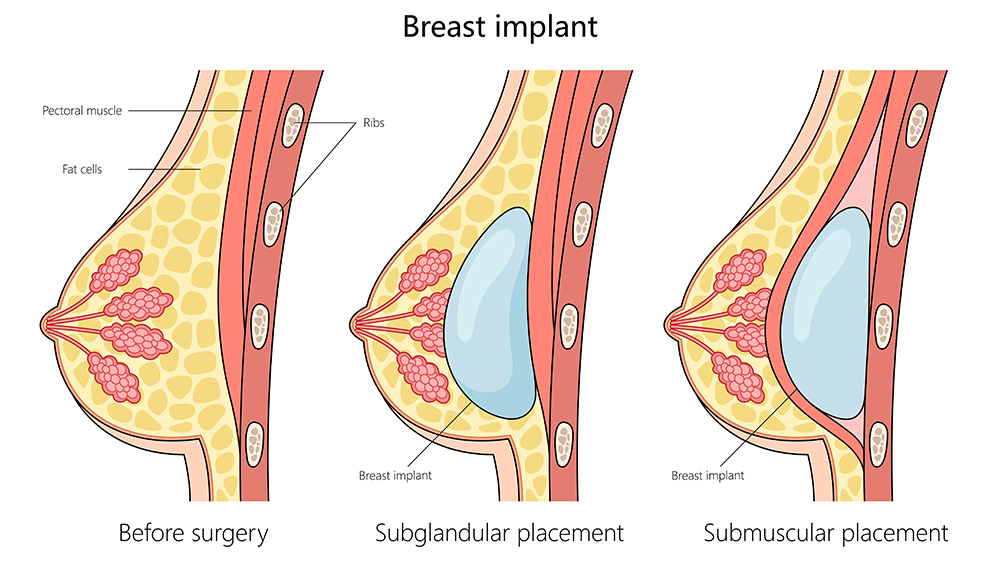
There are multiple differences between under-the-muscle vs over-the-muscle implants, including appearance, movement and feel.
Under the Muscle vs Over the Muscle Implants: Key Differences
Appearance and Natural Contour
Under-the-muscle implant placement often creates a softer and more gradual transition from the chest wall to the upper breast. This can be particularly beneficial for patients with thinner tissue coverage, as the muscle helps soften the visibility of the implant.
Over-the-muscle placement can create greater upper breast fullness and cleavage, which some patients prefer for a rounder appearance. However, in patients with limited natural tissue coverage, the implant edges may be more noticeable.
Factors such as body shape, breast tissue thickness and skin quality all influence which placement is likely to achieve the most natural and balanced result.
Implant Movement and Feel
One consideration with under-the-muscle placement is animation deformity, where the breast temporarily shifts or changes shape when the chest muscle contracts during activities such as weight training or push-ups.
For many patients, this movement is mild and not noticeable during everyday activities, although it may be more apparent in highly active patients or those with well-developed chest muscles. With over-the-muscle placement, the implant sits independently from the chest muscle, so this movement does not occur.
Recovery and Early Healing
Recovery following under-the-muscle placement is often associated with more tightness and discomfort early on, as the chest muscle is elevated during surgery. Some patients compare the sensation to muscle soreness after intense chest exercise.
Over-the-muscle placement generally involves less disruption to the chest muscle, which may lead to a more comfortable early recovery period. However, the overall recovery timeline is relatively similar for both approaches.
Long-Term Support and Rippling
Rippling refers to visible folds or wrinkles of the implant that may become noticeable beneath the skin. It is more common in patients with thinner tissue coverage, larger implants or saline implants. Under-the-muscle placement provides additional coverage over the implant, which can help reduce visible rippling and soften implant edges over time.
With over-the-muscle placement, the implant relies more on the natural breast tissue and skin for support. In slimmer patients, visible implant edges or rippling may become more noticeable over time.
What Are the Pros and Cons of Under the Muscle Breast Implants?
Under-the-muscle breast implants, also known as submuscular or dual-plane implants, are among the most commonly used implant placements in breast augmentation surgery.
Benefits
Placing the implant beneath the chest muscle can help create a softer and more natural transition in the upper breast, particularly in patients with thinner tissue coverage. The additional muscle coverage may also help reduce visible rippling and improve concealment of the implant edges.
Under-the-muscle placement can also provide additional support for the implant over time. In some cases, breast imaging such as mammography may also be slightly easier to interpret when implants are positioned behind the muscle.
Considerations
Recovery following under-the-muscle placement is often associated with more tightness and discomfort during the early healing period, as the chest muscle is elevated during surgery.
Another consideration is animation deformity, where the breast may temporarily shift or move during chest muscle contraction. While this is often mild, it may be more noticeable in highly active patients or those who regularly perform upper-body strength training.
Some patients may also notice the implants initially sitting slightly higher on the chest before gradually settling into a more natural position during recovery.
What Are the Pros and Cons of Over-the-Muscle Breast Implants?
Over-the-muscle breast implants, also referred to as subglandular implants, may be suitable for selected patients depending on their anatomy and desired outcome.
Benefits
As the chest muscle is not affected during surgery, recovery is often more comfortable in the early stages compared to under-the-muscle placement. This placement can also create greater upper breast fullness and projection, which some patients prefer aesthetically.
As the implant sits separately from the chest muscle, movement-related changes such as animation deformity do not occur, making this approach appealing to some athletic patients and bodybuilders.
Considerations
Without the additional coverage provided by the chest muscle, the implant relies more heavily on the natural breast tissue and skin for support. In patients with thinner tissue coverage, this may increase the likelihood of visible rippling or noticeable implant edges. Over time, natural changes in skin quality, ageing and weight fluctuations may also make the outline or shape of the implant more apparent in some patients.
The best implant placement depends on factors such as body shape, tissue coverage, and lifestyle.
Which Implant Placement is Best for Your Body Type?
Whether implants are placed over or under the muscle depends on a combination of factors, including body shape, tissue coverage, lifestyle and the type of result you wish to achieve.
Patients With Less Natural Breast Tissue
Patients with thinner tissue coverage or naturally smaller breasts often benefit from under-the-muscle or dual-plane placement. The additional muscle coverage can help soften the upper breast contour while reducing the visibility of implant edges or rippling.
Athletic and Active Patients
For highly athletic patients, particularly those involved in bodybuilding or heavy upper-body strength training, over-the-muscle placement may be considered to reduce the likelihood of animation deformity during muscle contraction. However, for many recreational gym-goers and active patients, under-the-muscle placement remains a suitable and commonly used option that still supports an active lifestyle.
Patients With More Existing Breast Tissue
Patients with greater natural breast tissue often have greater flexibility in implant placement. With adequate soft-tissue coverage, both over-the-muscle and under-the-muscle placement can produce natural-looking results, with the final decision guided by anatomy, implant selection, and aesthetic goals.
Patients After Pregnancy and Breastfeeding
Pregnancy and breastfeeding can affect breast volume, skin elasticity and tissue support. In many post-pregnancy patients, dual-plane placement is commonly used to balance implant support with a softer and more natural breast shape.
Patients Seeking Specific Aesthetic Goals
Patients seeking a softer and more natural upper breast contour often suit under-the-muscle or dual-plane placement. Those who prefer more noticeable fullness in the upper breast may consider over-the-muscle placement, provided there is sufficient tissue coverage to support the implant.
A Tailored Approach to Breast Augmentation
Choosing between over-the-muscle and under-the-muscle implant placement involves more than deciding where the implant sits. The most appropriate approach should take into account your anatomy, tissue characteristics, lifestyle and desired outcome, while also supporting long-term comfort, balance and implant support over time.
At MK Plastic Surgery, Mr Manaf Khatib takes a personalised approach to breast augmentation, carefully assessing factors such as chest shape, tissue quality and the type of result each patient hopes to achieve. He has a particular interest in breast augmentation surgery, is known for his meticulous surgical technique and has a patient-focused, ethical approach to care.
To learn more about breast augmentation and the different implant options available, you can visit MK Plastic Surgery or book an appointment to explore treatments tailored to your needs.
FAQs
Are under-the-muscle breast implants better?
Under-the-muscle implants are not automatically “better,” but they are often preferred for patients with thinner tissue coverage because the muscle helps soften implant edges and reduce visible rippling. However, over-the-muscle placement may be equally suitable depending on the patient’s anatomy and goals.
How do breast implants under the muscle feel?
Breast implants placed under the muscle are often described as feeling softer in the upper breast due to the additional muscle coverage. During early recovery, some patients experience temporary tightness or pressure while the muscle heals.
Which breast placement looks more natural: under or over the muscle?
Under-the-muscle or dual-plane placement often creates a softer and more natural upper breast contour, particularly in slimmer patients. However, over-the-muscle placement can also look natural when there is enough breast tissue to adequately cover the implant.
Is under-the-muscle breast implant placement more common?
Yes. Under-the-muscle and dual-plane placement are more commonly used in breast augmentation surgery in the UK because they can provide additional implant coverage and reduce visible implant edges in suitable patients.
Do breast implants look smaller under the muscle?
Implants placed under the muscle can appear slightly less prominent initially because part of the implant is covered by the chest muscle. Once healing is complete, the implant size itself remains unchanged, although the overall contour may appear softer.
Is it better to go with under-the-muscle or over-the-muscle breast implants?
Neither placement is universally better. Under-the-muscle placement may suit patients seeking a softer contour or more implant coverage, while over-the-muscle placement may appeal to those wanting greater upper breast fullness or less movement of the implant during chest exercises.







 Online Marketing For Doctors